The Brown Springs community, located across the Ouachita River about eleven miles northeast of Arkadelphia near the Hot Spring-Clark County line, was once known as a popular “watering place.” The site became a destination for visitors and tourists—people enjoyed the spring water, the scenic beauty, and the restful surroundings.
In the early 1830s, settlers began to occupy areas to the east of the Ouachita River. At the place now known as Brown Springs, the 160-acre tract on which a half-dozen or so springs emerge from the ground was originally deeded by the State of Arkansas to H. L. Brown. The springs were named for him after he moved to Texas, but according to local historian Farrar Newberry, were first known as “Sulphur Springs,” for the presence of sulphur in the water there.
Many special events and gatherings were held at the springs through the years. Area residents visited there too, especially in the summer months. Early on, Brown Springs had a brush arbor that hosted many different religious gatherings, and the Anchor Baptist Church was permanently established in the years following the Civil War. In addition to religious meetings, picnics were held often at the place, political candidates would campaign there, and visitors of all kinds enjoyed outings to the area. Demand was such that the Dove Park Boarding House opened for the purpose of providing accommodations for visitors who did not want to camp out. Before the days of air conditioning, it was said to be “a good house with cool and pleasant rooms.”
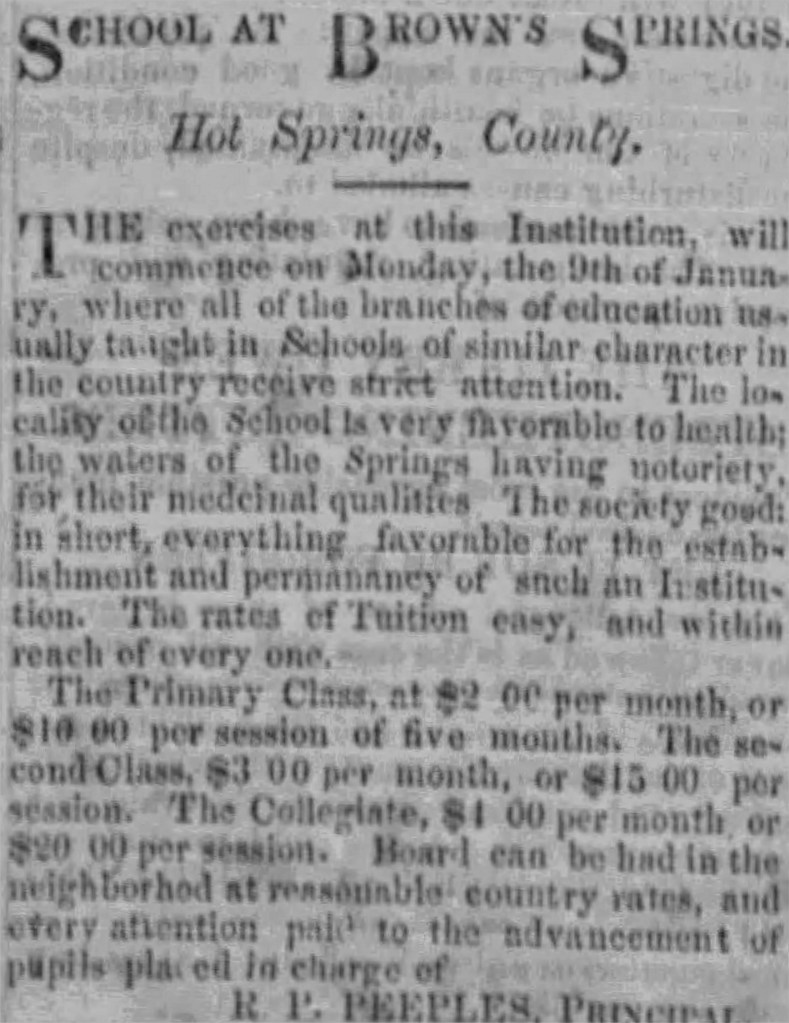
While Brown Springs reached its greatest popularity with visitors and tourists about 1910, it also had a school several decades earlier. A brief announcement of the beginning of the school’s winter term is found in the Arkadelphia Southern Standard newspaper in January of 1871: “The School at Brown’s Springs, under the charge of Mr. R.P. Peeples, will commence on Monday next. Mr. Peeples has no superior as an instructor of youth, his system being thorough and practical, and his discipline strict but gentle. The location of the school possesses many advantages, it being in a good neighborhood where board can be obtained on reasonable terms and convenient to a spring of rare medicinal qualities.” An advertisement about the school term ran for a number of weeks, beginning in January 1871.
 arkansashistory.online