An interesting character from Clark County’s Reconstruction Era was Judge Elhanan J. Searle. Searle often found himself at odds with the Arkadelphia Southern Standard’s editors in the tumultuous years following the Civil War. An attorney who worked in Abraham Lincoln’s law office prior to the war, Searle’s career crossed several states, with his departure from Arkansas coinciding with the end of Reconstruction.
Elhanan John Searle was born in 1835 in Illinois. He grew up there and received his education at River Seminary at Northwestern University, earning bachelor’s and master’s degrees. While there he studied law, and after graduation moved to Springfield, Illinois, where he worked in the law office of Abraham Lincoln and William Herndon. When the Civil War broke out Searle turned down a commission from then-President Lincoln and enlisted as a private in the 10th Illinois Cavalry, U.S.A., but eventually rose to the rank of lieutenant colonel.
Searle was sent to Arkansas at the end of 1862. In January of 1863 he served with Col. James Johnson in Fayetteville and began to recruit men from the area into the United States Army. He gradually became the de facto leader of the First Arkansas Infantry, since Johnson was often away.
Portions of Searle’s military service introduced him to the Clark County area. For example, late in 1863, the First Arkansas occupied Waldron, which then served as a base for various scouting missions and expeditions, some reaching into southwest Arkansas. One took place in November when part of the unit attacked a Confederate camp near Mount Ida. Several Confederates were killed, and Arkadelphia’s Major J.L. Witherspoon (Governor Harris Flanagin’s law partner) was captured.
Serving with the First Arkansas, Searle became a part of General John Thayer’s Frontier Division at Fort Smith. Thayer’s troops participated in the Camden Expedition of the Union Army’s failed Red River Campaign in the spring of 1864. Searle passed through Clark County and southwest Arkansas during this mission.
After the war, Searle stayed in Arkansas and opened a law practice in Fort Smith. When the Republicans gained control of state government, he received various appointments –prosecuting attorney, district attorney, and judge. According to the Southern Standard, “Judge Searle” arrived in Clark County in April of 1869 as he began service as Circuit Judge. 1870 census records place him in Caddo Township, Clark County, with his occupation as “lawyer and circuit judge.” He was only thirty-four.
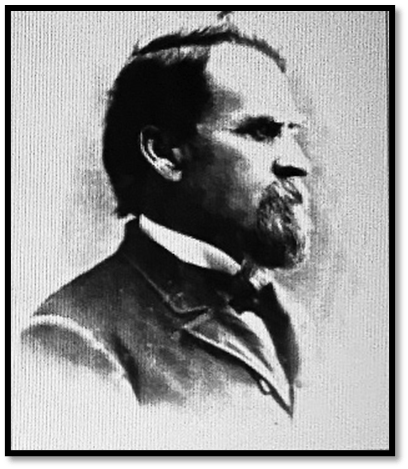
The Reconstruction Era in Arkansas proved to be a difficult time socially, economically, and politically. As a close ally of Republican Governor Powell Clayton, Searle often found himself the focus of sharply-worded Southern Standard editorials. The staunch ex-Confederate editors even complained about his 1869 Fourth of July speech in Arkadelphia that they characterized as “nothing more nor less than an inflammatory political harangue, calculated to inflame.” The editors’ rhetoric finally led to Searle ordering their arrest in an effort to silence them. Adam Clark and J.W. Gaulding were both fined $25.00 and Gaulding jailed for ten days. According to Clark, it was “because the Standard dared to tell of their rascally doings.”
Governor Powell Clayton appointed Elhanan Searle to the Arkansas Supreme Court in February 1871, and the judge became embroiled in the famed Brooks-Baxter War. The Court attempted to wield power over the legislative branch by ruling that Joseph Brooks had won the gubernatorial election of 1872, even though Elisha Baxter already occupied the office. By trying to make the decision ahead–and instead–of the legislature, one scholar characterized the Court’s planned move as a “judicial coup d’etat.” In the process, Searle and a fellow justice were famously kidnapped by Baxter supporters to prevent the court from formally rendering a decision. The men were freed after a short time, and even though the Court declared Brooks the winner, President Ulysses S. Grant proclaimed Baxter to be the rightful governor, ending the dispute. Searle and two other justices were impeached and removed from office.
As another noteworthy part of his career, Elhanan Searle also served on the State Board of Education, playing a role in establishing the Arkansas Industrial University at Fayetteville in 1872. He was also a member of the university’s first board of trustees. The school is now known as the University of Arkansas.
With the Republicans’ power vanishing as Reconstruction came to an end, Searle left the state permanently and ultimately returned to Illinois. At the time, the St. Louis Republican stated that “Judge Searle, Chief Justice McClure and other Arkansas travelers of Brooks’ lost cause are said to be making for Canada.”
Elhanan J. Searle died in 1906 in Rock Island, Illinois.
 arkansashistory.online