Samuel Roane played an active role in the development of Arkansas Territory’s government and legal system. While he is best known for his accomplishments in places other than Clark County, Roane was among the earliest purchasers of Clark County land from the federal government. In fact, he was present at the very first session of Clark County’s Circuit Court, and his name can be found frequently within the county’s early records.
Samuel Calhoun Roane was born in North Carolina in 1793 and served in the War of 1812. He became a lawyer and his name appears on page 1 of Clark County Circuit Court Book A, which documents the court’s first session in June 1819: His commission as Prosecuting Attorney for Clark, Hempstead, Pulaski, and Arkansas counties became a matter of record. Shortly thereafter, the August 12, 1820, Arkansas Gazette formally announced Roane’s presidential appointment as the United States District Attorney for Arkansas Territory. Roane performed in that capacity for a number of years, later becoming a territorial circuit judge.
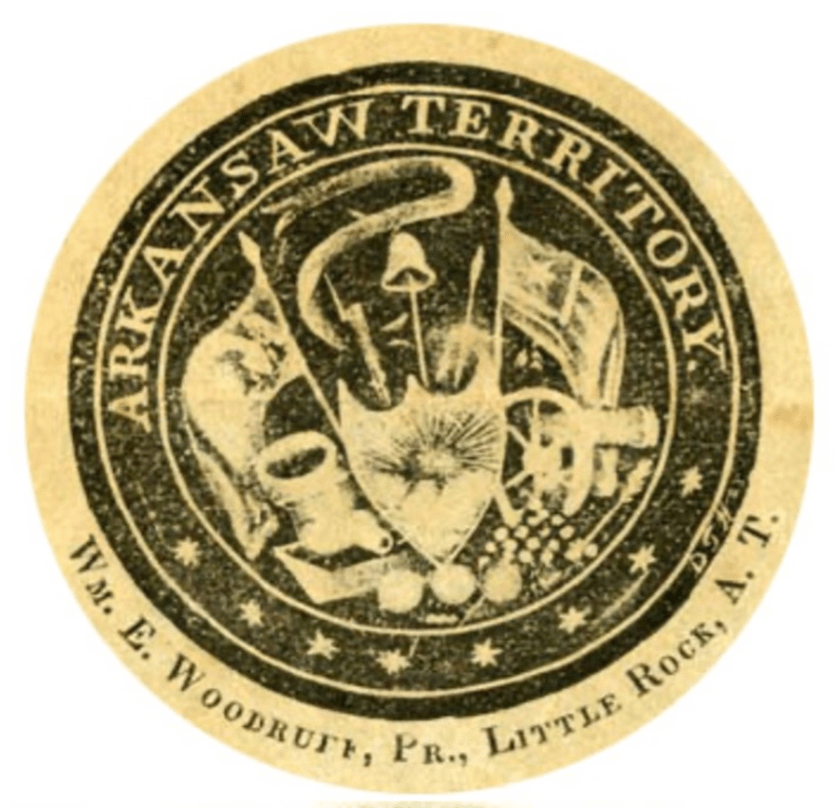
He also became active in politics. In 1820 Roane became the “engrossing clerk” at the first session of the Arkansas Territorial Assembly. It was during this time that he designed the territory’s official seal—a seal that continued in use for decades to signify the authenticity of state documents (with an update to the name reflecting statehood). Today, the Arkansas State Archives preserves images of the seal’s various versions.
Clark County citizens elected Samuel Roane to the Legislative Council (similar to Senate) of 1821 and 1823, and he served as the Council’s president during both terms. He later served in the Council from Jefferson and Arkansas counties.
Because of his significant roles in the Territorial Assembly, Roane saw a rare opportunity and acted upon it. He compiled “A Digest of the Statute Laws of Arkansas Territory,” the first work of its kind for the new territory. And, once statehood was achieved, the state legislature provided for Roane and William McKinley Ball to prepare the first collection of Arkansas statute law. It was adopted in 1838 by the General Assembly as “Revision of the Laws of the State of Arkansas,” and published by William Woodruff. Since that time, lawyers, judges, public officials, and others have relied on various such digests of state law in their work.
Notably, Samuel Roane was among the first to acquire land in Clark County from the federal government. The United States’ Louisiana Purchase in 1803 had spurred American settlement of land west of the Mississippi River, so to allow the formal, legal individual ownership of land to begin, the United States started surveying its new territory. Most of the land that is now Clark County was surveyed by the early 1820s.
With the new system in place, Clark County pioneers wasted no time in formalizing the ownership of their land. In fact, the very first patent issued by the U.S. General Land Office in Little Rock was to Mary Dickson of Clark County on December 5, 1823. But Dickson’s “Certificate No. 1” was not the only one issued by the land office that day. Among the others obtaining Clark County land were Adam Stroud, Jacob Barkman, Thomas Fish, Nancy Hemphill, Jacob Stroope, John Wilson, Abner Hignight, and Samuel C. Roane.
Samuel Roane received eighty acres in Section 35, Township 6 South, Range 20 West. This land was not far from the confluence of the Caddo and Ouachita rivers, and the primitive pathway that became known as the Southwest Trail and Military Road. Coincidentally, Roane’s property sat adjacent to land claimed on the same day by Clark County pioneer Jacob Barkman.
Re-appointed by the president as Attorney for the District of Arkansas in 1825, Roane’s interest shifted to other places. For example, in 1826 he was chosen to be a Trustee of the town of Little Rock. Then, in 1827, Roane was elected Justice of the Peace in Pulaski County. He served as the Judge of the Territorial Circuit Court from 1831 to 1836. Roane then represented Jefferson County as a state senator in 1836-1837. He also served as a delegate to Arkansas’s Constitutional Convention of 1836, playing a role in the creation of the state’s first constitution.
By the time his younger brother John moved to Arkansas in 1837, Samuel C. Roane’s reputation had grown, and he was regarded as “a leading jurist and owner of one of Arkansas’s largest plantations.” As such, he was able use his influence to give John a boost in Arkansas politics. John Roane studied law under his brother, got himself elected to the General Assembly, served in the Mexican War, and famously dueled with Albert Pike (neither was injured). Then, John Roane became the state’s fourth governor (1849-1852).
Samuel C. Roane died in Jefferson County in 1852. The steamboat “Exchange” carried his remains to Little Rock for burial in historic Mount Holly Cemetery.
 arkansashistory.online