Among Clark County’s earliest settlers was pioneer Abner Hignight, who moved to the area shortly after the beginning of the nineteenth century. According to legend, Hignight traveled southwest from Missouri into Arkansas, following the primitive path that was later called the Southwest Trail or Military Road. He eventually settled along that road, about two miles west of Hollywood. It is believed that he built a sizable log home there after his arrival and lived in it for the rest of his life.
Clark County was one of the five counties in existence when Arkansas Territory was created from Missouri Territory in 1819, and local government activities began at that time. Hignight served on Clark County’s first grand jury, with court held at the home of fellow pioneer Jacob Barkman. Court records indicate that Hignight played an active role in the area’s initial development, since he was also appointed to “lay out a road from Barkman’s by James Bryan’s store to Jacob Wells’ and from the Terre Noire to the Little Missouri River.”
According to Hignight’s son, Abner enhanced the area’s progress in various ways. For example, he traveled to New Orleans and returned with Clark County’s first seed corn, initiating an improvement in agriculture. In 1823, after the U.S. land office opened in Washington, Arkansas, he officially acquired land on the east side of the Terre Noire Creek where the road from Hollywood to Antoine crosses the stream today. Time went on, and Abner Hignight became “moderately prosperous” as he amassed almost 300 acres. Among his holdings was a field which contained a large salt lick that provided ample salt for his farm’s cows. Previously, buffalo frequented the place. Perhaps that is what drew Hignight to the location, for he was best known as a buffalo and bear hunter.
Early traveler George William Featherstonhaugh visited Arkansas and Clark County in the 1830s and encountered Hignight during his time in the area. Featherstonhaugh actually spent a night at the Hignight home and described Abner’s preparations for a bear hunt: “His dress consisted of a hunting jacket and leggings made of skins tanned by himself. He had a cap made of skin, a girdle around his waist, in which were stuck his hatchet and butcher knife, and a rifle weighing sixteen pounds on his shoulder. He used two pack horses to carry Indian corn for their subsistence and some necessary articles for himself, and to bring back the returns of his hunting. The most important part of his retinue consisted of eight dogs which he valued very highly and especially the older ones, on account of their great sagacity and prudence.” His appearance and personality must have been quite striking, for another man writing in 1904 described Hignight as “a great curiosity to those who did not know him,” and “a rough diamond of the first water.”
Descendants have reported that Abner Hignight believed he discovered lead ore on his property, but that he would never tell anyone where it was located—not even his family. Through the years various relics and artifacts have been discovered on the land, such as horseshoes.
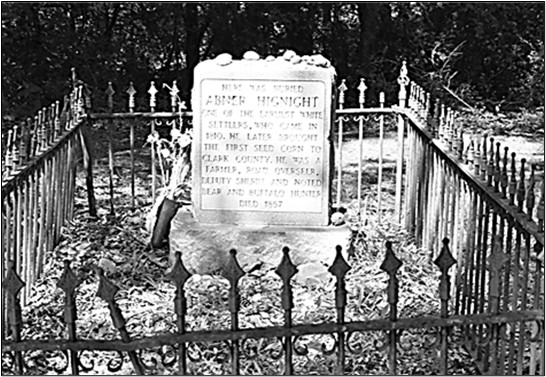
Abner Hignight died in 1857. While the precise location of his burial is unknown, a monument stands near Highway 26 and Terre Noire Creek in recognition of the Clark County pioneer.
 arkansashistory.online