A building in the 600 block of Main Street in Arkadelphia may hold that city’s record as the longest-serving commercial structure to have functioned continuously in housing the same type of business—a jewelry store. After purchasing the building from John McCabe, Sam A. Rudisill opened his Rudisill Jewelry Store there in 1875. Rudisill operated the business until 1920 when he retired, selling the place to Rob Finger. Finger called his establishment the Gem Jewelry Store. Although Finger died in 1957, his family continued the enterprise, which endured until 1992.
Sam Rudisill was born in Tennessee in 1836 and came to Arkadelphia in 1858. Little is known about his first years in Clark County, but during the Civil War he served in a unit known as Roberts’ Company of Clark County Light Artillery. Captured in 1863 in Tennessee, he was held as a prisoner-of-war at Camp Chase in Ohio, and later at Fort Delaware, Delaware. Prior to his imprisonment he suffered a head wound from a saber at the Battle of Chickamauga which left a noticeable scar visible for the rest of his life.
After the war was over Rudisill returned to Arkadelphia and married Mary Elizabeth Morehead in 1867. Sadly, she died just five years later. The couple had three daughters: Myrtle (married Rev. J.C. Lloyd), Hattie (married Dr. L.G. Poe), and Annie, who died at age seven. Mary Elizabeth and Annie were buried in the old Wilson Cemetery, which once existed on the grounds of what is now Henderson State University. Interestingly, Hattie Rudisill’s wedding was the first such ceremony held in the then-new (1903) Presbyterian Church.
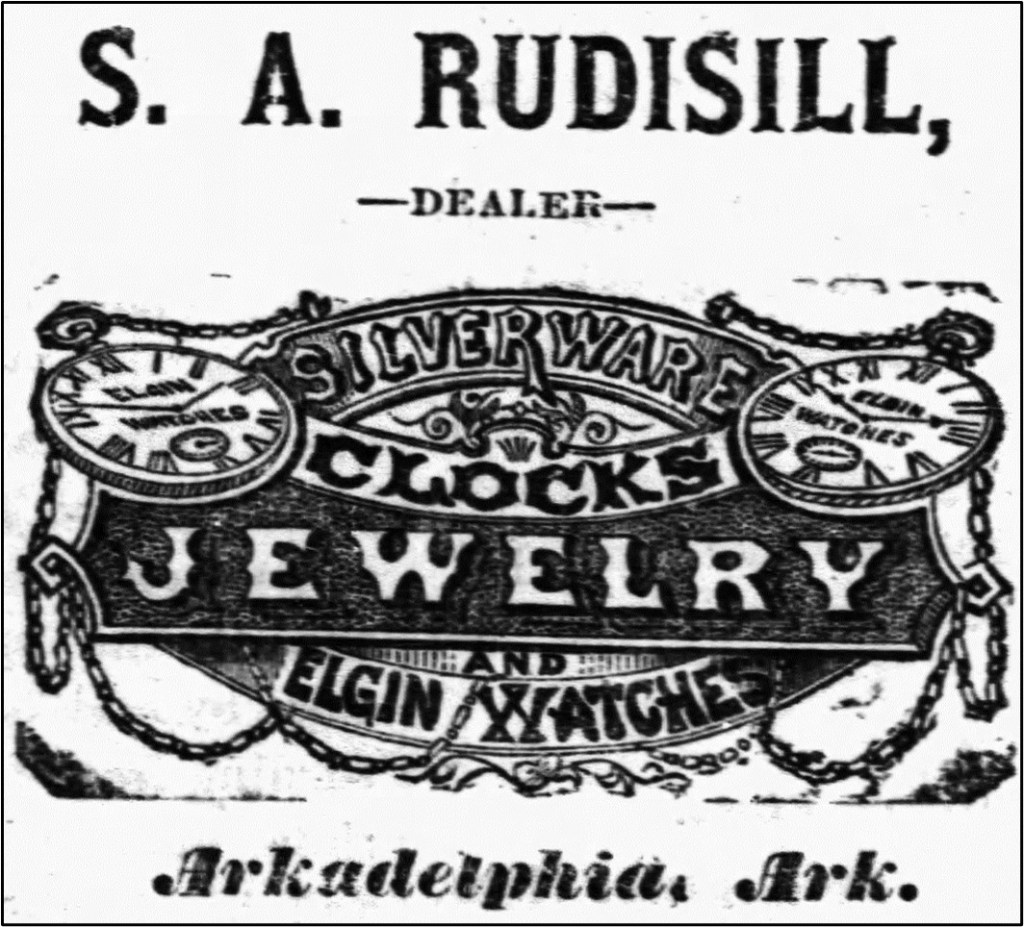
According to local historian Farrar Newberry, Rudisill was “a quiet, unassuming man of small physical stature, always neatly attired and in all his dealings the considerate and gracious gentleman.” Rudisill’s granddaughter echoed that sentiment, stating that he was “the most perfect example of a Christian gentleman.” Newberry also observed that while the jeweler was “never a joker or boisterous laugher, he nevertheless had a keen sense of humor and often displayed it in the business ads he placed in local papers.” One of the ads read, “What is this world coming to, anyway? Why, to Rudisill’s for jewelry, of course!” The ad below is from 1877.
The façade of Rudisill’s building was not large. The one-story brick’s interior measured only sixteen feet wide and went about ninety-five feet back to an alley. The structure was damaged in a 1913 fire but was quickly repaired. And, Rudisill’s operation was not confined to just jewelry, for he also worked on and sold items such as sewing machines, eyeglasses, and timepieces.
A doting grandparent, he always made sure his grandchildren enjoyed pieces of trending jewelry and other novelty items. When they got older, he gave them very nice gifts. One of Rudisill’s granddaughters recalled his disciplined use of tobacco: “He had a habit of taking one chew a day. After dinner he would retire to the yard, cut a sizeable slice from a plug with his pocketknife and chew it leisurely and at length. The routine over, he would go directly into the house and brush his teeth. And that was his total indulgence until the next day.”
After Sam Rudisill sold his business and retired from the business world, he lived alternate years with his daughters. Rudisill died at his daughter Hattie’s home in Newark, Arkansas, in 1928 and was buried there.
Rudisill’s building at 614 Main was added to the National Register of Historic Places in 2011 as a part of the Arkadelphia Commercial Historic District. The district’s boundaries extend approximately from Fifth to Seventh along Main, and on Clinton between Sixth and Ninth streets. The National Register documentation states that Rudisill’s is “most likely the oldest surviving commercial building in the district.”
 arkansashistory.online