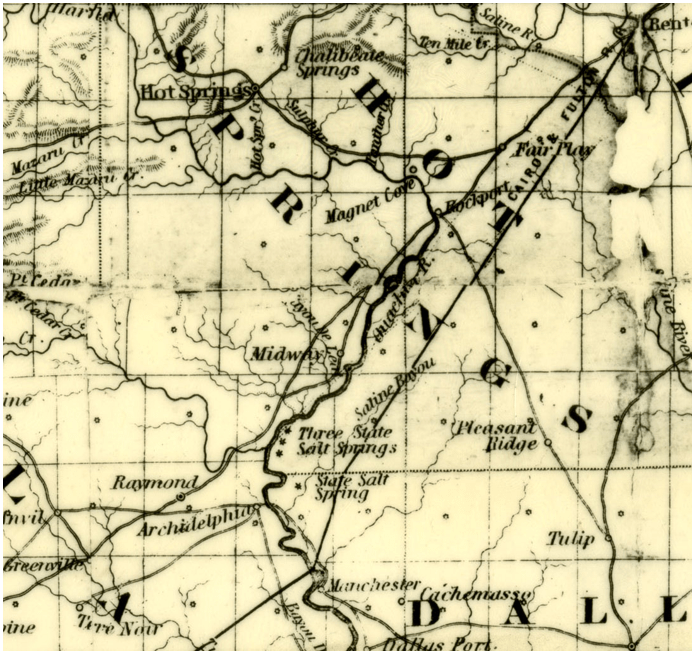
Back in the 1800s, when horses were relied upon for transportation, horse stealing ranked as a heinous crime. Even so, some thieves managed to escape the consequences of committing such an act, at least for a while. According to one pioneer resident, the first horse he recalled having been stolen in this region was by a man named Rube Timmons from the farm of Andrew Briggs, six miles east of Arkadelphia. Later the farm was known as the Jesse Harris place. The story came to light in the late 1890s, when reminiscences of an early citizen of Dallas and Clark counties were published intermittently in Arkadelphia’s Southern Standard newspaper. The writer called himself “Pioneer” and “Old Pioneer,” but his identity is unconfirmed.
This is how “Pioneer” told the story of the dastardly deed: “A man by the name of George Washington, with his young wife, from Virginia, were looking at the country on horseback. They each rode a fine horse. Now Rube Timmons followed them for two days, and on this night, January 1849, Washington and his wife put up at Andrew Briggs’. Their horses were stabled and saddles hung in the gallery of the dwelling. A large bulldog lay near the saddles. Timmons, however, slipped the saddles from near the dog, saddled up the horses, and started north via Hot Springs.
“Next morning Briggs collected a few good men and started in pursuit of the thief. Think of it—three pioneers with flintlock rifles, and an old Virginia dude with a pair of derringers! Andrew Briggs, James YBlood [Youngblood] and Mad Hoodenpile pursued and captured the thief fifty miles north of Hot Springs and brought him back.
“Timmons belonged to John A. Murrell’s clan, and had his horse’s shoes marked, so he was easily tracked. He led two horses and made fast time. Briggs with his posse traveled but a few miles behind him for a day and half a night. A few Murrellites collected at the place of arrest and demanded Timmons’ release but Briggs’ men with their flintlocks soon cleared the place. They tied Timmons on his own horse and brought him back in haste.
“At Hot Springs another effort was made to rescue him by a J.P. Briggs told him that a flintlock rifle was mightier than his court, and they brought their prisoner on and placed him in jail in Princeton. The jail being weak, Timmons made his escape, and we never heard of him again.
“Timmons had served a term of four years in the Tennessee state prison, and many of his old neighbors from Madison County, Tennessee, had quite a handshaking after they convinced him that his name was Rube Timmons instead of Tom Smith. I will explain. John A. Murrell was a celebrated robber, and his family was raised in Madison County, Tennessee. I was well acquainted with his wife and daughters. I saw Mrs. Murrell a few years ago and talked with her about her husband. She said the book, ‘The Life of John A. Murrell’ was a false book, and was written for money.
“Murrell was a good neighbor, and one of the most charitable men in the country. He was convicted of stealing from a man by the name of Hendrix in 1835, and sent to state prison for a term of two years. I have heard that he was a very successful preacher. It was said that he would get up a big revival and have all the unconverted crying for mercy, while his clan would be around stealing horses. Murrell was considered one of the shrewdest men in the country, and when one of the clan exposed the league, some of the highest standing men in the country were found on the record.
“Now this Rube Timmons was one of Murrell’s clan, and the last we ever knew of him was when he escaped from the Dallas County jail.”
 arkansashistory.online