During the first week of April 1864, thousands of troops traveled into southwest Arkansas as a part of the Civil War’s “Red River Campaign.” The great conflict had begun three years earlier, in 1861. Arkansas seceded from the Union in May of that year. While much of the major fighting occurred east of the Mississippi River, a good deal of small-scale activity took place in the West, including Arkansas. Federal troops occupied Little Rock in September of 1863, and the Confederate state capital moved southwest to Washington (near Hope) with Arkadelphian Harris Flanagin as governor. Confederate control continued in southwest Arkansas, but the Union held most of the rest of the state. Both sides were ready for an end to the conflict.
Early in 1864, Union leaders hatched a plan to defeat the Confederates in the Southwest. This Red River Campaign would deploy General Nathaniel Banks from west of New Orleans to link with Admiral David Porter’s Mississippi squadron on the Red River and infantry troops from east of the Mississippi to move toward Shreveport. General Frederick Steele would simultaneously move south from Little Rock to join forces with Banks. After occupying the rest of Arkansas and Shreveport, the army intended to invade Texas and bring the war to an end in this region.
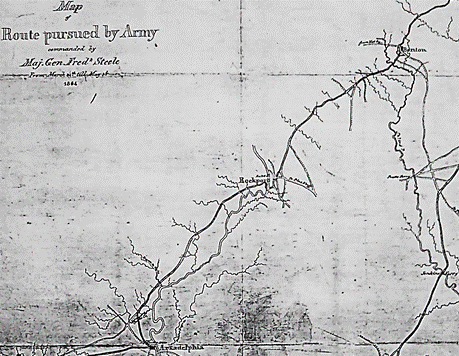
So, to execute this strategy, in late March, Steele ordered General John Thayer’s division at Fort Smith to join him in Arkadelphia, as he headed south from Little Rock. Steele’s troops moved down the Military Road, crossed the Ouachita River at Rockport on a pontoon bridge, and then, the thousands of Union troops moved toward the southwest.
A Union soldier summarized his experiences as a participant in what became known as the “Camden Expedition” in a section of his journal that he titled “Travels of regiment and battles”: Left Little Rock March 23, 1864. Got to Arkadelphia March 29th, 1864. Left Arkadelphia April 1st, 1864. Had a battle at Terre Noir Creek April 2nd, 1864. Got to Little Missouri River and had a battle April 4th, 1864. Had battles at Prairie D’Ane April 10th, 11th, and 12th. Had a battle fifteen miles west of Camden and took the place April 15th, 1864. Left Camden April 26th, 1864. Had a battle at Jenkins’ Ford on Saline River April 30th, 1864. Got to Little Rock May 3rd, 1864.
According to the diarist, Larkin Melson of Company K, 29th Iowa Infantry, his regiment lost in battles at Terre Noir Creek on April 2nd; Elkins’ Ford on April 4th; Prairie D’Ane on April 10th, 11th, and 12th; Camden on April 15th, Jenkins’ Ford on April 30th. 117 men killed, wounded, and missing.
Melson assessed the situation correctly. After being held off by the Confederates along the way and running low on rations, he and the rest of Steele’s Union soldiers changed direction, headed east, and occupied Camden before returning to Little Rock. The Federals failed to achieve the overarching purpose of the Red River Campaign, that of putting a quick end to the war in the region. The Civil War continued for another year.
After the war was over, Larkin Melson traveled to Davenport, Iowa, but then came back to Arkansas, settling in Montgomery County across the Ouachita River from Cedar Glades (now under the waters of Lake Ouachita).
 arkansashistory.online