Mussels live in lakes, streams, and rivers in Arkansas and around the world. To live, they need cool, clean water. They prefer water containing some mineral content, which they use to build up their shells. This freshwater mollusk–like its salt-water counterpart, the oyster–creates pearls. Following discoveries in other parts of the country and in the state during the years around the turn of the twentieth century, Arkansas and the upper Ouachita River valley experienced what the Malvern Times Journal characterized as “pearl fever.”
Rivers in Arkansas have historically contained freshwater mollusks capable of producing pearls. Early on, archeological evidence indicates that American Indians used the pearls they found for ornamentation and as a part of their burial traditions. Such treasured items occurred only naturally in those earliest days, before the development of cultured pearls. This made pearls quite special.
In the 1800s a discovery in the northeastern United States netted the finder a small fortune, setting off a flurry of activity that spread across the country. Freshwater mollusks were easy to find, and anyone could find a pearl inside them. People from all walks of life began to hunt for treasure. Families might even spend their vacation time searching for pearls, enjoying the time spent camping or outdoors, whether or not they found anything! They always remembered, though, that every mussel represented the “potential to pay for a farm, release all debts, and change a life.” Some reports stated interest was so great that crops were left unharvested and employers experienced difficulties keeping folks on the job.
Arkansas’s pearl rush began just before the beginning of the twentieth century following several major discoveries in northeast Arkansas. That region of Arkansas became a popular place to search for pearls. However, the “pearl fever” spread to other parts of the state.
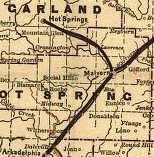
One major discovery in the upper Ouachita River valley happened quite by chance. In June of 1902, a merchant from Potash Sulphur Spring, between Malvern and Hot Springs, was paid $139.50 by Tiffany of New York for a Ouachita River pearl. The pearl was found in the river near Lawrence Station, a stop on the rail line.
A man was baiting a trot line with mussels in an attempt to catch some catfish from the river. When he opened one of them, he saw some type of hard substance, but didn’t really think much about it. He put it in his pocket and continued baiting. When finished, he gave the pearl to Mr. Smithson, a merchant at Potash Sulphur Spring, thinking that it might have value. The pearl was egg-shaped, weighed fifteen grains, and viewed by Smithson as a potentially valuable find. Smithson sent it to New York for appraisal, and in turn, received the offer for $139.50, which was accepted.
Pearl fever died down a few years later, even though pearls continued to be found, and are still found occasionally today. In the early part of twentieth century, freshwater mussel shells came to be used in mother-of-pearl buttons, creating yet another valuable use for the mollusks. https://imgur.com/a/pexFPjE
 arkansashistory.online