Following the Louisiana Purchase in 1803, United States citizens trickled, then later streamed into the Trans-Mississippi South. Cheap land attracted many to Arkansas, and people of all income levels moved to the area in search of prosperity. Thousands of early nineteenth-century Arkansas settlers followed major rivers to principal tributaries, then to secondary waterways, and finally into the uplands areas. For this river travel, steamboats grew in significance on the Mississippi River and other inland streams. The Comet reached Arkansas Post in 1820, and in 1822, the Eagle became the first steamboat to travel up the Arkansas River to Little Rock. And, one future southwest Arkansas businessman distinguished himself in river travel endeavors during the mid-1800s.
John Smoker was born in 1817 in Pennsylvania. He moved to Illinois at age fifteen and worked as a clerk for three years. He then moved to New Orleans, where in 1838 he began his career as a steamboat commander on the Mississippi and Red rivers. By 1845 he was providing express mail service between the Red River region and New Orleans. John Smoker built and navigated at least seven different steamboats, and also commanded several others at various times, among them the Latona, New Latona, Robert Watson, News Boy II, Governor Allen, Belle Lee, and the Jeff Thompson. In 1863 Smoker reportedly partnered in the construction of the Missouri, which became part of the Confederate Navy, the last such vessel to enter Confederate service. Captain John Smoker rose to the top of his profession during the glory days of river transportation.
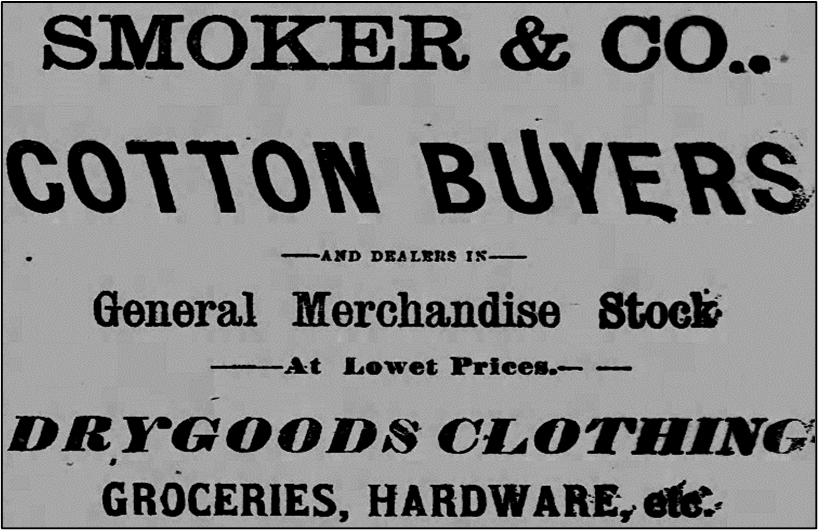
Smoker found himself at the center of a legendary event of the riverboat era. He was among the lucky few to be on board during the world-famous race between the steamers Robt. E. Lee and the Natchez in 1869. A New Orleans newspaper described the significance of the event this way: “The people of the entire Mississippi Valley have been excited about this race as they never were before by any similar event, and the banks of the great river were thronged with thousands of deeply interested spectators during the progress of the race, all along the route from New Orleans to St. Louis.” Even with the intense interest in steamboats, other major developments in transportation were taking place. Initial efforts had been largely disrupted by the Civil War, but railroad construction expanded after the conflict was over, connecting the east and west coasts in 1869. Perhaps Captain John Smoker realized the end of the steamboat era loomed on the horizon, for not long after his participation in the renowned river race he moved to Arkadelphia and opened a business he called “Smoker & Co.” The enterprise grew to be one of the leading cotton-buying and general mercantile operations in southwest Arkansas. The change of profession proved to be a wise decision, for river transportation quickly declined in importance following the railroad’s completion into southwest Arkansas in 1873. Smoker continued to successfully conduct his business in Clark County until he died in 1893. He is buried in Rose Hill Cemetery in Arkadelphia.
 arkansashistory.online