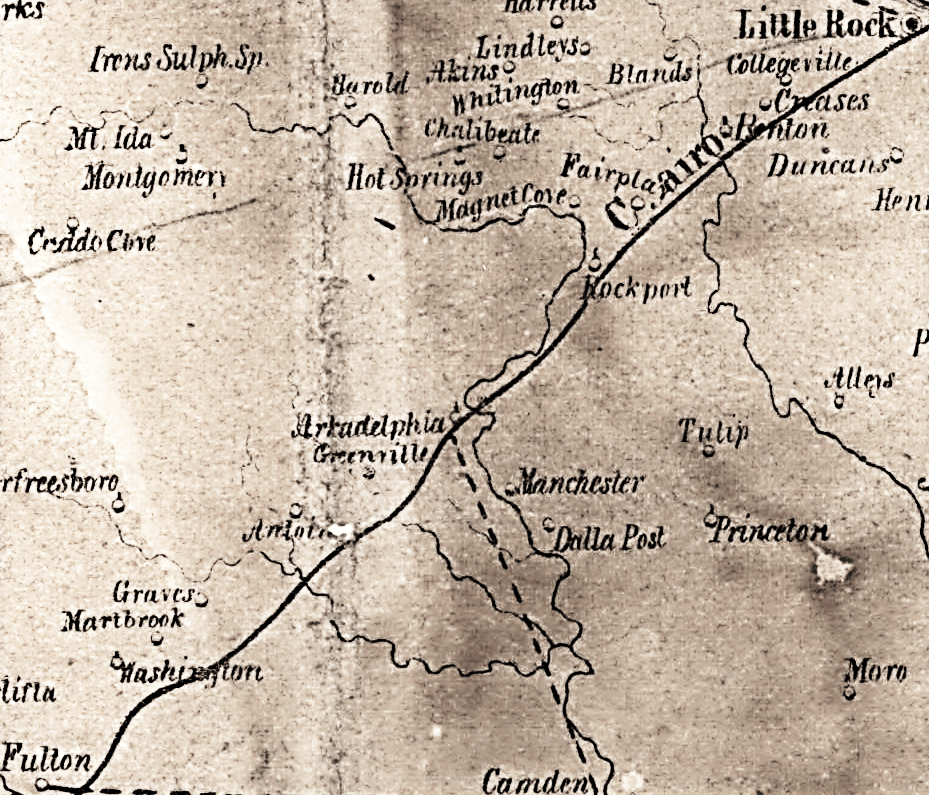
An early visitor to Arkansas was geologist George William Featherstonhaugh, who visited the state and Hot Spring County in the 1830s. The book about his travels, titled “Excursion Through the Slave States,” was published in 1844. There is much to be learned about the upper Ouachita River valley from Featherstonhaugh’s writings. While he seemed to be impressed with the area’s natural features and wildlife, Featherstonhaugh believed the state’s cultural development lagged behind other parts of the country. One of his recollections about his time in the area illustrates his perception of frontier Arkansas:
“This fine river ‘Washita,’ at the point where we reached it, is about 200 yards broad, and the view to the west is very beautiful, a graceful little island presenting itself in the centre of the stream, which terminates in a lofty hill of sandstone covered with pines and oaks. Having crossed the river in a ferry-boat, we found that the road for a considerable distance ran parallel with it, and was exceedingly wet and spongy. At the end of four miles we left this wet ground, and got again upon a sandstone country with high knolls, and continued on it for five miles, until we descended into a bottom through which a stream called Prairie Bayou runs, and here we stopped at a settler’s called Mitchell.
“This was one of the most wretched places we had yet met with in our journey. The supper consisted of some pieces of dirty-looking fried pork, cornbread eight days old, mixed up with lumps of dirt, and coffee made of burnt acorns and maize; they had neither milk, sugar, nor butter. Just as we were sitting down to it two hours after dark, Colonel Conway rode up: he laughed at our fastidiousness, and advised us to drink some of the corn-coffee, which he had often done with success when he could get nothing else; and he showed us how to get through the operation, by nipping his nose with his fingers and swallowing it exactly as if it had been castor oil. He left us soon afterwards. We passed a wretched night on the hard boards of a sort of barrack, into which the wind freely entered, and were glad when morning dawned to creep to the fire.
“Our breakfast was in keeping with everything we had found here; so after putting a few things up in a bag, we started for the Caddo River, about seventeen miles off. For fourteen miles of this distance our route lay amongst sandstone hills and isolated knolls of petro-siliceous matter, many of which approached in their structure to the novaculite of the Hot Springs. The streams were numerous, and some of them very much swelled. The Candleberry Myrtle (Myrica cerifera) was exceedingly abundant on these knolls, amongst which we had constantly some deer in sight, besides numerous flocks of well-grown wild turkeys; these often came strutting across the road showing their beautiful glossy plumage to the greatest advantage, and on perceiving us would take flight with as strong a wing as the wild-goose, wheeling around and then alighting upon the tallest pine trees. It was altogether a fine wild romantic ride, changing from broken hills to numerous streams—some of which were very much swollen—that flowed through limited bottoms of great fertility. Three miles before we reached the Caddo, the country began to descend, and a change soon took place in the aspect of nature, and of everything around us.”
 arkansashistory.online