One of the upper Ouachita River region’s most memorable organizations is the Concatenated Order of Hoo-Hoo, founded in Gurdon in 1892. Established for lumbermen, it is among the oldest world-wide industrial fraternal organizations in existence today. At the height of its popularity at the turn of the twentieth century, the group had thousands and thousands of members.
The town of Gurdon had its origins as a railroad town. After the new Cairo and Fulton Railroad decided to establish a stop at the location, the place needed a name. According to local legend, the community was named “Gurdon” for one of the surveyors of the railroad’s right-of-way, Gurdon Cunningham. Population grew quickly, resulting in the need for a post office, which opened there in 1876. In 1880, a petition signed by area residents requested that the town be incorporated. And, the forest products industry has always been an important part of Gurdon’s economy. The St. Louis Mill and Wood Cutter Company was among the town’s first businesses.
Back in 1892, while traveling on the railroad, a forced layover in Gurdon gave the Hoo-Hoo’s founders plenty of leisure time with little to do but come up with some very creative plans for a new organization. Most of that handful of men were returning from a meeting of the Arkansas Yellow Pine Manufacturers Association at Camden. At the time, there was no national federation for those in the timber industry. Hoo-Hoo founders included Bolling Arthur Johnson, a Chicago journalist; George K. Smith of the Southern Lumber Manufacturers Association; William Starr Mitchell, business manager of the Arkansas Democrat; Ludolph O.E.A. Strauss of the Malvern Lumber Company in Gurdon; and George Schwartz of the Vandalia Railroad, St. Louis.
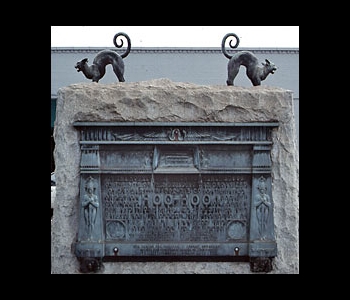
The term “Hoo-Hoo” is believed to have been coined by Johnson at a previous lumber meeting. The organization’s emblem and its officers’ titles are as unusual as the name of the society itself. For example, the Hoo-Hoo’s officers include the Snark of the Universe, who is assisted by others, such as the Scrivenoter, Bojum, Jabberwock, Custocation, Arcanoper, and, of course, the Gurdon. The black cat, with its tail curled into the figure “9” was chosen as the group’s logo. The cat’s “nine lives” supposedly assured the organization’s long existence, and the number played a significant role for the members. Original plans included nine officers, plus, clubs were to meet at nine minutes after nine on the ninth day of the ninth month. Initiation fees were $9.99, and annual dues were set at 99 cents per year.
The Hoo-Hoo Museum and International Headquarters were established in Gurdon, its place of origin. For decades, the organization published a magazine distributed to its members called “Log and Tally.” A bronze plaque set in a granite stone stands in Gurdon north of Main and west of North First Street near the railroad depot to commemorate the Hoo-Hoo’s existence. It reads: The Hotel Hall, which formerly stood on the site of this building, was organized on January 21st, 1892, the Concatenated Order of Hoo-Hoo, a society composed of lumber men and those in allied industries and having for its object the promotion of health, happiness, and long life of its members. These were present on that occasion: Bolling Arthur Johnson, William Eddy Barns, George K. Smith, William Starr Mitchell, George W. Schwartz, and Rudolph Albert Strauss. The marker was removed from Hotel Hall (mentioned on the marker) and placed in its granite monolith on the grounds of the railroad station in 1927. It was added to the National Register of Historic Places in 1999.
 arkansashistory.online