As many old-timers once exclaimed, “There’s gold in them there hills”!!! Indeed, gold, silver, and other valuable minerals were once mined in Hot Spring County! In fact, in the late 1880s, Hot Spring County experienced a mining boom of sorts. A local paper described the center of activity as the “Meyers Creek Mining District, which encompasses a number of hills and mountains, dips, spurs, valleys and gulches, including Trap Mountain and neighboring upheavals of less magnitude in Hot Spring County.” The same article claimed that “extensive prospecting is going on, the outcome of which cannot as yet be foretold.” Certainly, the tremendous boom enjoyed by the communities of Bear and Silver City in western Garland County prompted developments in the nearby areas.
At first, the finds appeared to be significant. According to one report, “Gold has been found there and in a class of rock that abounds there, but in its present shape no developments can be made without a smelter and other apparatus.” One claim being worked had exposed a vein of a “peculiar” ore, which was a black, bituminous-looking substance, with occasional strata of white quartz. According to one man, the rock was “well nigh inexhaustible.”
In 1887, a number of newspaper reports told of mining activity in Hot Spring County. In May of 1887, one man wrote that “Our mining interest seems to widen. Theo Fenter and son are going to organize a mining company and form a mining district, taking in Township 5, Range 20, the boundaries to be set by the company. Captain Holstine is still getting fine ore from Section 22, Township 4, Range 19.”
Mining activity was described as “brisk,” but more equipment was needed to make the endeavor worthwhile. Smelters and additional rail lines could help develop the minerals of Hot Spring County. One mine was said to be “cutting good ore in small quantities.” Another report stated that two men began to “cut ore” in Township 4, Range 21 West, as “the people are beginning to learn what to look for and where to look for the minerals.” A nearby discovery was proclaimed as “no doubt the richest find in the state, and the gray ore is cut at least thirty feet above the level of the creek. The large quantity and richness, with the easy drainage, will make it a perfect success.”
In August of the same year, a newspaper reported on an “exhibition of some very fine specimens of gold and silver found seven miles north of Arkadelphia.” The owner claimed he had “found it rich, richer than California ever was.” A new company was established to handle the mine.
But, alas, even with the numerous discoveries, the mining boom of Hot Spring County met with the same fate as so many other short-term endeavors designed to enable men to “get rich quick.” It proved more expensive to extract and transport the ore than its final value, so gold and silver mining activity soon declined and life returned to normal.
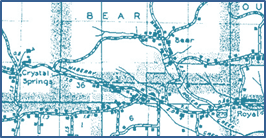
the location of another mining boom
 arkansashistory.online