Today, Lake DeGray offers many outdoor, water-based recreational opportunities for the people of Arkansas. The dam and lake bring many benefits to the south-central Arkansas region by reducing flooding while producing electric energy and maintaining excellent water quality. It has been a boon to the economy of the area as well, through the recreational opportunities it creates. The lake and dam were both named for DeGray Creek, a small creek in northern Clark County that wound its way through the hills for about nine miles before emptying into the Caddo River at a point just below the present location of the dam.
DeGray Dam’s story really began to take shape in November of 1955, when the Corps of Engineers held a public hearing in Arkadelphia concerning the construction project. Many central Arkansas leaders voiced their support, including senators John L. McClellan and J.W. Fulbright, Congressman Oren Harris, and Governor Orval Faubus. After passing various hurdles in Congress, the green light for construction finally came in 1961 with passage of the Federal Water Pollution Control Act Amendments.
Plans called for an earthen dam with a crest length of 3,400 feet, rising 243 feet above the river bed. The dam formed a lake covering 13,400 acres with a 207-mile shoreline. DeGray Dam was constructed through contracts executed under the supervision of the U.S. Army Engineer District in Vicksburg, Mississippi.
Work first began late in 1962 with construction of an access road and concrete bridge over the Caddo River. Ten years and millions of man-hours and dollars later, Senators John L. McClellan and Allen Ellender ceremonially pushed the switch activating the powerhouse at the dam in 1972.
Today, the Corps of Engineers maintains a number of sites on the lake for camping and picnicking. DeGray State Park and Lodge on the north side of the lake includes a lodge complex, marina, golf course, campgrounds, swimming beach, riding and walking trails, and other supporting facilities. With all of this, Lake DeGray offers some of the most comprehensive outdoor recreational facilities in all of Arkansas.
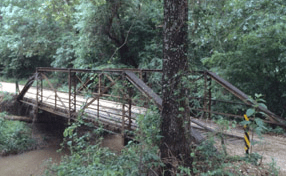
The memory of the area prior to the dam’s construction is preserved by a large boulder from the foundation of the dam’s core section which was placed on the grounds of the Clark County Court House by County Judge B. W. Hasley in 1967. The boulder remains there today for the public to view. Also related to the DeGray name, a bridge over DeGray Creek was added to the National Register of Historic Places in 2010 (see image from Arkansas Historic Preservation Program). The one-lane bridge has the distinction of being the only known surviving pin-connected Pratt pony truss bridge in Arkansas. It is believed that its trusses were purchased by Clark County about 1915 during a period of road building and bridge construction undertaken to meet the increasing needs of then-new automobile traffic.
 arkansashistory.online