The Cairo and Fulton Railroad line established Malvern as a railroad station in the early 1870s. Today’s Union Pacific Railroad runs from the Missouri state line to Little Rock and then on to Texarkana. It was originally constructed by the Cairo and Fulton Railroad. Over the course of several decades, the Cairo and Fulton first became a part of the St. Louis, Iron Mountain and Southern Railroad, then Missouri Pacific, and finally Union Pacific. The Cairo and Fulton played a major role in Arkansas’s economic development by connecting the state to the rest of the nation. Malvern served as an important stop on the rail line.
The railroad facilitated shipment of the area’s raw materials to other parts of the country, including agricultural and forest products. Another key development, though, also increased Malvern’s significance as a transportation center. Coinciding with the coming of the railroad, the nearby resort city of Hot Springs was enjoying a boom of its own. More and more people wanted to visit the town, creating a demand for easier access to the spa’s facilities located in the midst of the Ouachita Mountains. So, Joseph “Diamond Jo” Reynolds built a railroad line from Malvern to Hot Springs to serve the transportation needs of the thousands of visitors to the spa city. The Diamond Jo Railroad was completed in 1875 and enabled even the infirm to make their way to the famed hot springs.
The combination of these rail lines stimulated development of the new town of Malvern. Rockport, located at the intersection of the Military Road and the Ouachita River, had long been the center of activity in Hot Spring County, and had served as the Hot Spring County seat. In just a few short years, though, with increased importance of rail travel, Malvern became the county seat in 1878. Malvern was officially incorporated in 1876, with Samuel Henry Emerson, owner of the town’s first dry goods store, as mayor.
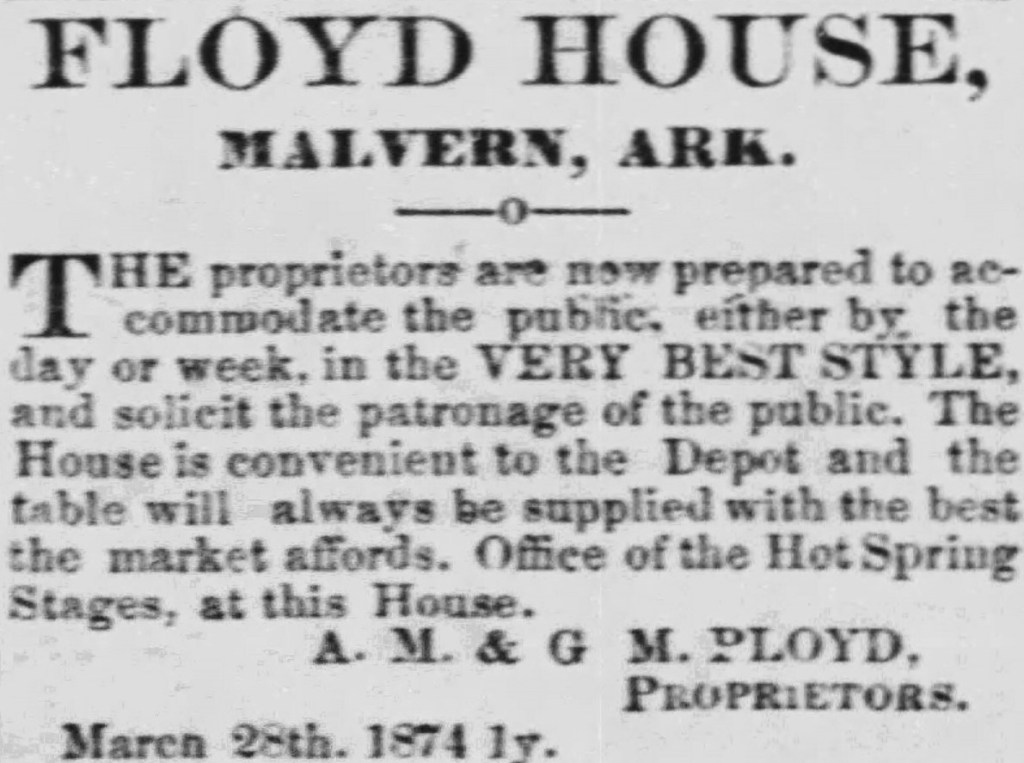
The editor of Arkadelphia’s Southern Standard newspaper visited Hot Spring County in the summer of 1874, about a year following the railroad’s arrival, and echoed the changes described above: “On last Monday, we made a business trip to Malvern and stopped with our friend, A.M. Floyd, who keeps a first-class hotel convenient to the depot. He has recently overhauled his house and is now fully prepared to accommodate all that will stop with him. After eating dinner, Mr. Floyd kindly loaned us his horse and we rode over to Rockport, about two miles’ distance, and spent an hour or two. The place did not present a very lively appearance, but looked more like a deserted city, most of the merchants having moved to Malvern. The Court House that was commenced over a year ago is not yet completed. Crops that we saw on the road were looking better than we expected to see them. They have had more rain in that county than we have had in this.”
 arkansashistory.online