An early Hot Spring County businessman became well-known in a variety of places and professions in Arkansas. Lorenzo Gibson—store owner, doctor, postmaster, lawyer, surveyor—served the state and its people in a variety of ways. Several of his ventures were in Hot Spring County.
Lorenzo Gibson was born in Tennessee in 1804. Gibson had also studied law and was admitted to the bar in Tennessee, only to join the medical profession. He and his younger brother moved to Arkansas in 1833 and established a mercantile business in Little Rock, with branches in Pine Bluff and Rockport. Economic conditions forced Lorenzo Gibson out of business in the capital city, so he moved to Rockport.
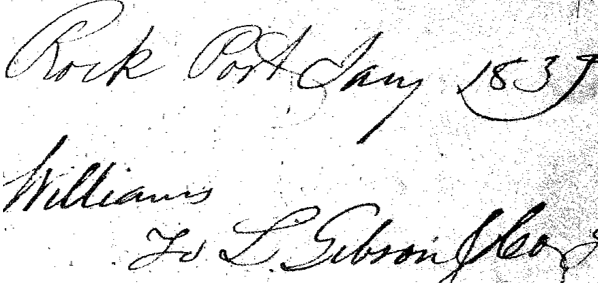
Gibson built a home on a bluff overlooking the Ouachita River and in 1837, became the town’s first postmaster. Other early settlers in the area included A.R. Givens, Henry Miller, and Samuel Emerson. Emerson is credited with laying out the city and opening a hotel there. Rockport’s physical landscape included a post office, court building, tavern, general store, doctors’ offices, law offices, blacksmith shops, and saloons, in addition to the homes of local residents.
By that time, Rockport had become a well-known landmark in Arkansas Territory. So called because of the distinctive rocks embedded in the Ouachita River, “Rockport” stood at the point of intersection of two major transportation routes—the Military Road and the Ouachita River. In the 1830s, the federal government improved the Military Road to facilitate travel across Arkansas Territory. Specifications called for removal of brush and saplings, but trees could be left several inches tall (depending on size). Travelers sometimes used the boulders found in the river to assist with crossing. A ferry operated at Rockport to ease the difficulties of passage across the Ouachita. Such ferry operations were licensed by county government, and rates were fixed by county courts.
Hot Spring County had been carved out of Clark County in 1829 with Hot Springs as the county seat, but the town of Rockport became the county seat in 1846. About 1847, one of Arkansas’s first toll bridges was constructed at Rockport, to cross the Ouachita River on the Military Road. It washed away just a few years later. It appears that Lorenzo Gibson moved back and forth between Hot Spring County and Little Rock until staying permanently in Pulaski County after 1849.
In politics, he served in the Arkansas House of Representatives from 1838 to 1841, and 1856-57, representing Pulaski County; and in 1842-43, representing Hot Spring County. In an attempt to further his political career, in 1844 he ran as the Whig candidate for governor, and almost won—Democrat Thomas Drew received 8,859 votes to Gibson’s 7,244, followed by an Independent candidate who won 2,507. Gibson also served as Surveyor General of Arkansas from 1850 to 1853 after being appointed to the post by President Zachary Taylor, who was also a Whig. Lorenzo Gibson died in 1866 and was buried in Little Rock’s Mount Holly Cemetery.
 arkansashistory.online