One of North America’s greatest natural events occurred in late 1811 and early 1812 when a series of earthquakes occurred along a fault line that extends about 150 miles northeasterly from Marked Tree (Poinsett County) across several states. The New Madrid Earthquakes caused extensive damage through northeast Arkansas and southeast Missouri, significantly changing the landscape and impacting the area’s settlement. Tremors were felt as far away as the East Coast—for example, church bells rang in Boston and pavement cracked in Charleston, South Carolina. About thirty years after the quakes, one man recalled what the tremors felt like in the upper Ouachita River valley.
Geologists identified the quakes’ epicenter as about three miles under modern-day Blytheville, Arkansas. However, the quakes were named for New Madrid, Missouri, since it was the only town in the region with a sizeable population, having about 400 people. The area that is now known as the state of Arkansas was very sparsely populated at the time.
Few first-hand accounts of the quakes’ effects in Arkansas exist, so a precise death toll is unavailable and written records are rare. Several factors contributed to a general lack of information about the events, such as illiteracy among residents, slow communication, and the area’s remoteness. Reports tell of almost incredible scenes—settlements disappeared as riverbanks collapsed and islands disappeared; riverboats capsized or wrecked as river channels changed their course; trees fell; and the earth shook violently. The landscape changed so significantly that the Mississippi River was said to have run backward! Some people believed the end of the world was near.
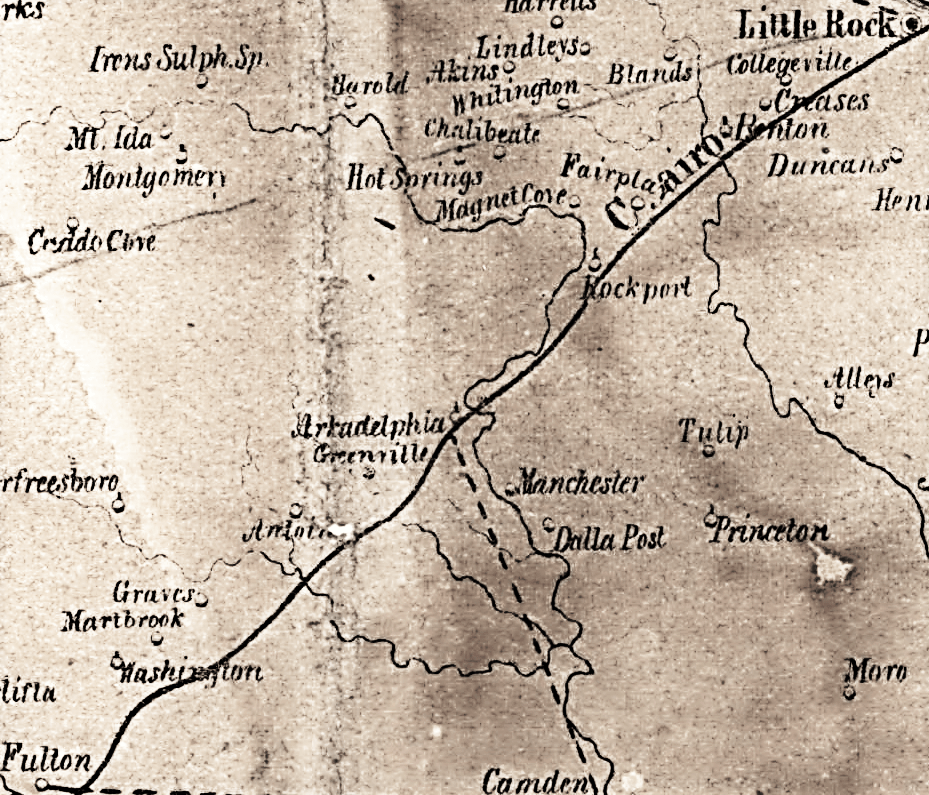
One man, identified by some researchers as Isaac Cates, provided an account of how the earth trembled in the Ouachita River valley. Cates was among the region’s pioneers, arriving in the area about 1804. Cates was said to have journeyed to Arkansas as early as 1801. According to one account, that journey began in 1799 or 1800 when a handful of Tennessee men “mounted their horses, shouldered their flint and steel rifles with their hack knives belted to their sides, tomahawks tied to their saddles, bid adieu to their friends and relations, turned their horses towards the west of the dim road leading to the crossing of the great father of waters [Mississippi River] which formed the western line of the United States of America.”
Cates moved around within the Ouachita River area during his first years in Arkansas, doing a lot of hunting. With several companions, in December of 1811 Cates left his home on the Little Missouri River in search of buffalo. Buffalo were plentiful in the area at the time, and the men planned to get enough meat for the winter season. While on the trail of their quarry, the hunters established a camp for the night after discovering “considerable signs of buffalo” in the vicinity. After bedding down for the evening, Cates stated he was awakened at about nine o’clock by a severe shock and felt himself moving back and forth on the ground due to the violent shaking. “Astonished, he arose and attempted to walk, but found that still more difficult.” More tremors occurred the next day. According to the report, “Old Nature awoke, and the rocky hills trembled, and the tall forest waved, and the valley was tossed as a raging sea. From Madrid to the Far West and throughout the valley of our proud stream [Ouachita River], the heaving of the earth was felt.”
Even more quakes followed, and tremors continued for months. Many settlers left portions of Arkansas, too scared to stay. Others’ homes were destroyed, or their fields became swampland. Needless to say, for a time, the population of northeast Arkansas declined. The New Madrid Fault remains active today, and small tremors are regularly felt in the region.
 arkansashistory.online
earthquake
LikeLike