Many Americans and Europeans were fascinated by the American West, and that interest made travel books quite popular in the early nineteenth century. Some of the earliest descriptions of Arkansas and other places west of the Mississippi River came from visitors and travelers. Potential emigrants also looked to literature for clues about where to seek their economic future, so these early accounts helped shape Arkansas’s development. A place described in some detail by a traveling scientist was what is today known as Magnet Cove. Just a small excerpt from his writings reveals how the place got its name.
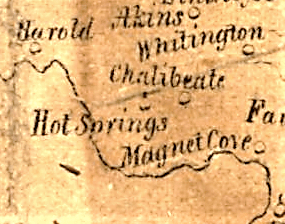
The work of geologist George William Featherstonhaugh (usually pronounced fan-shaw) was widely read by people in the eastern United States. Significantly, he visited Arkansas and Hot Spring County in the 1830s. Featherstonhaugh’s book, “Excursion Through the Slave States,” published in 1844, told of those travels. The following is a portion of his description of the visit to Magnet Cove, detailing some of the distinctive geological features he found there:
“I sallied out again to look at some localities where Colonel Conway had told me I should find some curious minerals. He had informed me that on surveying the country the needle would not traverse on approaching this locality, and the cause was here apparent from a mound in the Cove, covered with pebbles of magnetic micaceous oxide of iron from one ounce to four pounds weight. These pebbles, like those of the vein in Missouri which goes by the name of Iron Mountain, overlie masses of the metal of prodigious extent, which from their great magnetic force, probably influence the country around for a great distance. Some of the specimens which I brought away—especially one which contained a portion of a large crystal of iron—possess an intensity of magnetic power which is truly surprising.
“I found a great many Indian arrowheads made of a beautiful semi-transparent kind of novaculite; and in one place, an immense number of chips and broken arrowheads, all of this stone, were lying together. This had been evidently a favorite retreat for the Indians, but I looked in vain for the rock from which the novaculite had been taken.
“Upon considering all the circumstances connected with this cove, the intrusive character of its rocks, their distinct origin and separation from the sandstone, its minerals, the quasi-crateri form of the cove, and the immense deposit of magnetic iron, I could not but be impressed with the opinion that Magnet Cove owes its origin to an ancient volcanic action, and that it is one of those extinct craters that may have preceded that class where basalt and lava are the principal products.
“I left this place full of admiration; if it were in social respects a desirable situation for a residence, the proprietor would certainly possess one of the most enviable estates in America.”
 arkansashistory.online