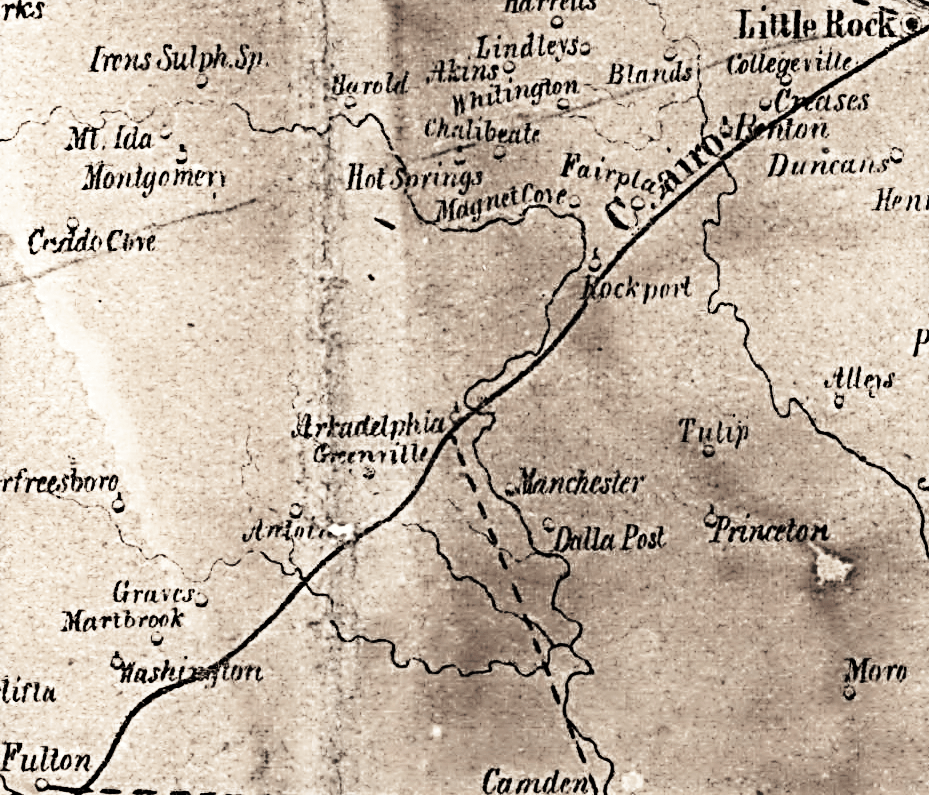
During the Civil War, on September 10, 1863, Union troops occupied Little Rock. General Frederick Steele’s Union army constructed a pontoon bridge south of the city and moved up both sides of the stream. After skirmishing at Bayou Fourche, the Confederates withdrew. Major troop movements took place as soldiers moved southwest along the Military Road. State government operations eventually got underway at Washington in Hempstead County, where they continued until the end of the war. Among the soldiers who made their way from Little Rock through Hot Spring County and on further south, was Richard Perry Harrison of the Confederate States Army.
Richard Perry Harrison was born in Arkansas in 1843. He joined the army in Benton County in the summer of 1861 and served in an engineering battalion, Company K, Thirty-Fourth Arkansas, Confederate States Army. As a part of this company, he spent most of his time in the war in south Arkansas involved in building bridges and performing other related projects.
Thankfully, Harrison wrote of his experiences in the war, entering information in his 42-page diary almost every day between July 1861 and May 1865. He recorded information about his unit’s travels for the duration of the war. These descriptions include Harrison’s report of his trip through Hot Spring County as his unit fell back from Little Rock in September of 1863.
When the federals occupied Arkansas’s capital city on September 10, Harrison matter-of-factly described the exodus of Confederate forces from the Little Rock area: “Evacuate Little Rock with a little skirmishing & march till after night when we lay down on the ground & slept till day.”
The trip toward south Arkansas was not without incident, however. He told that on the next day (September 11), “All of us very hungry, had nothing to eat and the wagons ahead. Camp on the Saline twenty-six miles from the Rock, find our wagons. Get supper & retire to rest. In the night some loose stock got in to camp & get frightened & every fellow hollers “hua,” thinking the cattle stampeded & they jumped to a tree. I got strait on my bed, but did not leave it.” The next day the troops started out early, and Harrison mentions there were “a good many boys deserting.” After marching all day, they camped “in an old field after dark.”
On September 13 they made it to Rockport. He described the day this way: “March hard and camp near Rockport on Ouachita River. I & one of the boys get some potatoes in the country, some others get a hog, and we have a fine mess of potatoes, pork, and biscuit.” The next day Harrison and the men marched again and camped on the river. By September 15, they arrived at Arkadelphia, “wade the river & camp on the bank.” Harrison’s company stayed in the area for about three weeks. They finally crossed the Little Missouri River on October 8. He spent most of the rest of the war in south Arkansas.
 arkansashistory.online